
Formula 1: FIA Technical Directive Updates — What Will Be Checked More Strictly in 2026
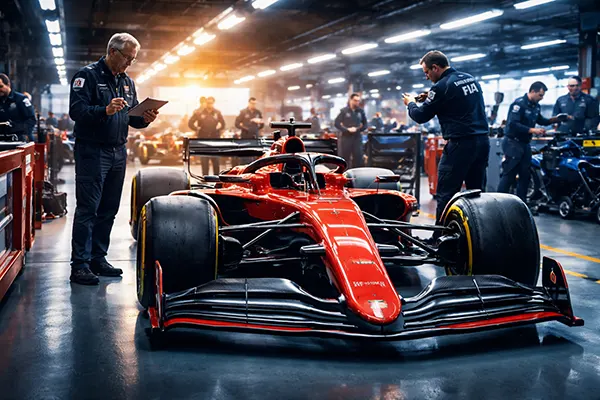
In 2026, Formula 1 enters one of the most significant regulatory cycles in its modern history. Alongside the new power unit architecture and revised aerodynamic philosophy, the FIA has updated and clarified several technical directives aimed at tightening compliance and reducing grey-area interpretations. These changes are not cosmetic. They directly affect car design, race operations and post-session scrutineering. Teams now face more detailed inspections in areas that previously relied on interpretation, particularly aerodynamics, power unit management and component flexibility.
Stricter Monitoring of Aerodynamic Flexibility and Bodywork Deformation
Since 2021, the FIA has progressively increased load tests on front and rear wings, but for 2026 the procedures are even more rigorous. Static deflection tests now apply higher loads and additional measurement points across wing elements. The governing body has refined the methodology to prevent teams from exploiting localised flexibility that passes a single-point test yet behaves differently at racing speeds.
Rear wing slot gaps and beam wing structures are under closer observation as well. After previous controversies surrounding “mini-DRS” effects, the FIA introduced real-time camera monitoring and high-speed video analysis. In 2026, this surveillance expands to include more detailed tracking of wing behaviour at maximum velocity, particularly on long straights where deformation can reduce drag illegally.
The floor edges and diffuser throat area are also inspected more strictly. With ground-effect cars still sensitive to ride height and airflow sealing, any flexible mounting or subtle movement under load is now subject to additional checks. Teams must demonstrate that skid blocks, plank assemblies and floor stays remain within tolerance throughout a race distance, not only during static scrutineering.
Enhanced Load Testing and In-Race Surveillance
Load tests are no longer limited to pre-session inspections. The FIA reserves the right to conduct targeted checks after qualifying or the race if onboard footage suggests abnormal deflection. This approach reduces the opportunity for teams to optimise components for a single inspection window.
High-resolution onboard cameras, combined with FIA reference markers, help detect micro-movements in wing elements. The data is cross-referenced with telemetry to determine whether aerodynamic gain may have been achieved through illegal compliance. The system has been refined for 2026 with improved calibration standards agreed with all teams.
Importantly, penalties for aerodynamic non-compliance are applied consistently under the International Sporting Code. Disqualification remains possible even if performance gain cannot be precisely quantified, reinforcing the principle that legality is not judged solely by lap time advantage.
Power Unit Oversight Under the 2026 Hybrid Regulations
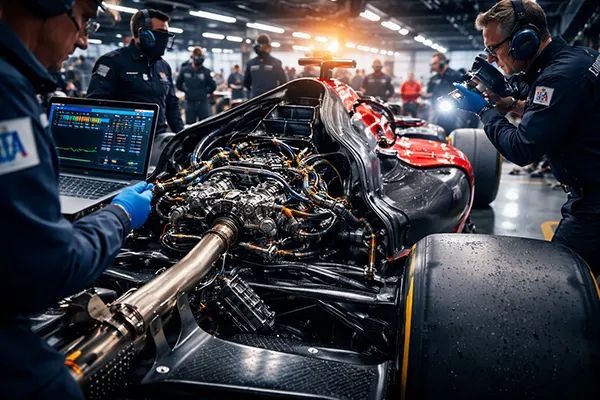
The 2026 power unit regulations introduce a 50% electrical energy split and the removal of the MGU-H, fundamentally changing deployment strategies. With greater reliance on battery power and energy recovery, the FIA has strengthened software monitoring to prevent unauthorised torque shaping or hidden deployment maps.
All engine manufacturers must submit updated control software for homologation. The FIA standard ECU, supplied by a single approved vendor, integrates additional logging capabilities. This ensures that electrical deployment patterns, battery discharge curves and energy recovery phases comply strictly with the sporting and technical regulations.
Fuel flow remains tightly regulated, but the introduction of 100% sustainable fuels in 2026 adds another verification layer. The FIA conducts chemical sampling before and after sessions to confirm compliance with sustainability criteria and combustion parameters defined in the regulations.
Software Transparency and Energy Deployment Control
Torque demand maps and throttle response curves are now analysed with greater granularity. The FIA can compare requested driver torque with actual delivered torque in real time, reducing the possibility of concealed traction control-style strategies, which remain prohibited.
Energy deployment during safety car periods, formation laps and out-laps is also scrutinised. The objective is to ensure teams do not exploit grey areas in harvesting or redeploying energy beyond prescribed limits. Data logging thresholds have been tightened for 2026 to eliminate ambiguity.
Manufacturers must provide detailed documentation explaining how their power unit control systems manage energy blending between internal combustion and electric components. This documentation forms part of the homologation dossier and can be audited throughout the season.
Component Durability, Cost Cap Compliance and Standardised Parts
With the financial regulations firmly embedded in Formula 1, technical directives increasingly intersect with cost cap oversight. In 2026, the FIA continues random audits of component lifecycles, particularly in high-value areas such as gearboxes, survival cells and suspension assemblies.
Standardised components, including wheel covers, fuel systems and certain electronic elements, are subject to traceability requirements. Teams must document manufacturing batches and usage cycles. Any unauthorised modification to a standard part can trigger both technical and financial investigations.
Durability expectations are aligned with the reduced number of allocated power unit elements per season. Exceeding component quotas still results in grid penalties, but stricter inspection ensures teams do not disguise upgraded parts as repaired originals.
Post-Race Scrutineering and Randomised Audits
Post-race scrutineering in 2026 involves more frequent selection of cars for detailed teardown inspections. The FIA may examine suspension pick-up points, steering systems and brake ducts to verify dimensional conformity with homologated designs.
Randomised checks act as a deterrent against incremental rule stretching. Teams are required to supply 3D CAD files and manufacturing drawings upon request, allowing the FIA to compare physical components with approved specifications.
Ultimately, the tightening of technical directives reflects Formula 1’s broader objective: maintaining competitive fairness while encouraging innovation within defined boundaries. For 2026, the message is clear — regulatory interpretation margins are narrower, and scrutiny is deeper than ever before.